Wine Futures: Never Bordeaux It
I’ll be the first to admit that I’m more of a “Modelo with a slice of lime” guy. I do most of my drinking when the Yankees are mashing homers to the short porch so it’s no surprise that I don’t know the difference between a five dollar glass of whisky and a glass of Gold Label Johnnie Walker. That being said, I can appreciate wine for what it is: a luxury product with high investment upside. When investors think of commodities, they think of soybeans, oil, or gold. Raw materials that are liquid and highly demanded by virtually every country across the globe. So, it makes sense that wine futures generally go under the radar of futures traders, as they are a more refined luxury good than a commodity. As a result, wine futures live in investment purgatory: not commodity-like enough to be traded by futures traders but not equity-like enough to be part of a long-term investment portfolio by retail investors. Lucky for us, hidden opportunities that are overlooked by the market are our bread and butter. Before diving into why I think wine futures have a lot of upside, let’s discuss the factors that influence the price of wine futures.
Please note that this analysis will focus solely on wines from the region of Bordeaux in France. By volume, Italy is the largest producer of wines. However, given that this analysis focuses on wine as a luxury product and not as a consumable good, we have chosen to isolate the region that is most well known for producing high quality and expensive wines.
The Magnificent Seven
There are seven key factors that affect the pricing of wine futures.
-
While most of these factors are not in chronological order, vintage quality is generally the “starting price” established by the chateau based on the manufacturing qualities of the wine. For example, if the climate conditions for a certain year yields the perfect sugar level, acidity, and ripeness of the grapes, then the entry price for that year’s bottles will be higher than in years with less optimal harvests. The vintage quality will always be the number 1 variable in the price of the wine.
-
Probably the number 2 variable after vintage quality, critics hold enormous power over wine future prices. After wines are tasted from the barrel, critics will issue a “wine rating” from 50-100. Notable wine critics include Neal Martin, Jancis Robinson, James Suckling, and the father of modern wine tasting, Robert Parker.
A wine rating moving from 95 to 98 can cause a future to increase by 20-50% in price.
-
Supply, particularly for premium wines from top vineyards in Bordeaux, is a large factor in determining the price of the wine. Years with droughts or excessive heat will see lower yields of grapes, which in turn lowers the number of available bottles.
-
While not as important as the preceding three factors, the reputation of the chateau or the estate has enormous influence over how the market receives the wine. First Growth chateaus in Bordeaux can fetch high prices even in years of mediocre harvests.
-
As with any commodity or product, market demand, particularly in the U.S., China, and Europe dictates the price of wine. Generally, wine tends to be more well-insulated than other luxury products.
-
Interest rates and FX fluctuations significantly impact supplier and distributor dynamics. In particular, periods of high interest rates reduce consumer willingness to lock in capital in wine for 2+ years. Additionally, USD/EUR rates impact importers’ willingness to take on foreign exchange risk.
-
The release strategy of the wine, while not as important, can dictate how the secondary market trades wine. For example, selling wine at moderate prices in higher quantities may foster higher levels of trading in the secondary markets.
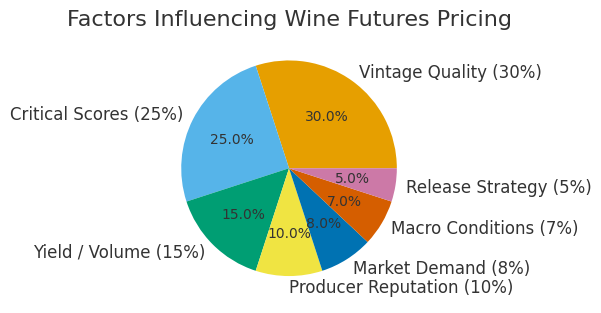
The best way to think about each of the seven factors is that they fall into two categories: upside and baseline. Vintage quality, which has the greatest impact on the end pricing, sets the baseline for the future. Critic scores and brand reputation provide upside for the future, increasing the value based on market perception of the underlying bottle. All factors considered, the weighting of the seven factors looks something like the below:
How Does Climate Affect Wine Quality
Climate includes many different conditions and forms of precipitation, all of which can affect the quality of wine. However, there are two major factors that will make or break the quality of a region’s wine: temperature and water.
The general rule is “a good year is a hot year.” The optimal temperature for each wine varies from grape to grape, however, vines need heat to mature. High temperatures will enhance carbohydrate and sugar production, in turn increasing the potential for alcohol concentration. In particular, for the region of Bordeaux, native grapes are generally slow to ripen, so the high temperature acts as an accelerant. Growing season generally starts in May and ends in September, while the harvest season generally starts in August and ends in November. Because these months generally include the hottest days of the year, changes in climate trends have significantly increased the number of days above 35 °C (~95 °F). From May 2025 to September 2025, there were a total of fifteen days on which the temperature exceeded 35 °C, including a span of seven consecutive days in August. For the mild-weathered region of Bordeaux, the rising temperature of the region poses a grave issue for châteaux. High heat days, in particular consecutive high heat days, cause sugar production to accelerate without the flavor of fully ripe grapes. Furthermore, high heat causes malic acid respiration, which makes wines taste aggressively sour and tart in lieu of the tangy bitterness of vintage wines. Finally, high temperatures overripen the grapes without ripening the tannins, which causes rough tannins and extreme bitterness, even if there is strong alcohol content. In other words, extreme temperatures significantly hurt the taste profile of the wine.
The other side of the equation is the dryness of the soil. Mild to moderate dryness is optimal for the vines; when surface level soil is moderately dry, roots are forced to grow deeper to absorb moisture and nutrients. Optimally dry soil will also limit the vigor (i.e., the rate of growth of the grape), which produces smaller, more heavily concentrated grapes with better flavor concentration and more tannins. The opposite also holds true, where lack of irrigation can lead to the underripening of grapes and stalling of sugar accumulation. These wines will be restricted in volume due to a lower usable grape quantity and generally have an unbalanced flavor profile.
These two factors don’t exist in a vacuum and actually work together to create optimal growing conditions. For example, optimal soil dryness will force the roots to grow deeper, which protects against higher temperatures at the surface. High temperatures can balance out periods of excessive rain and over-irrigation and can be optimal at the 32-35 °C range, which generally stresses the vines without adequate water reserves.
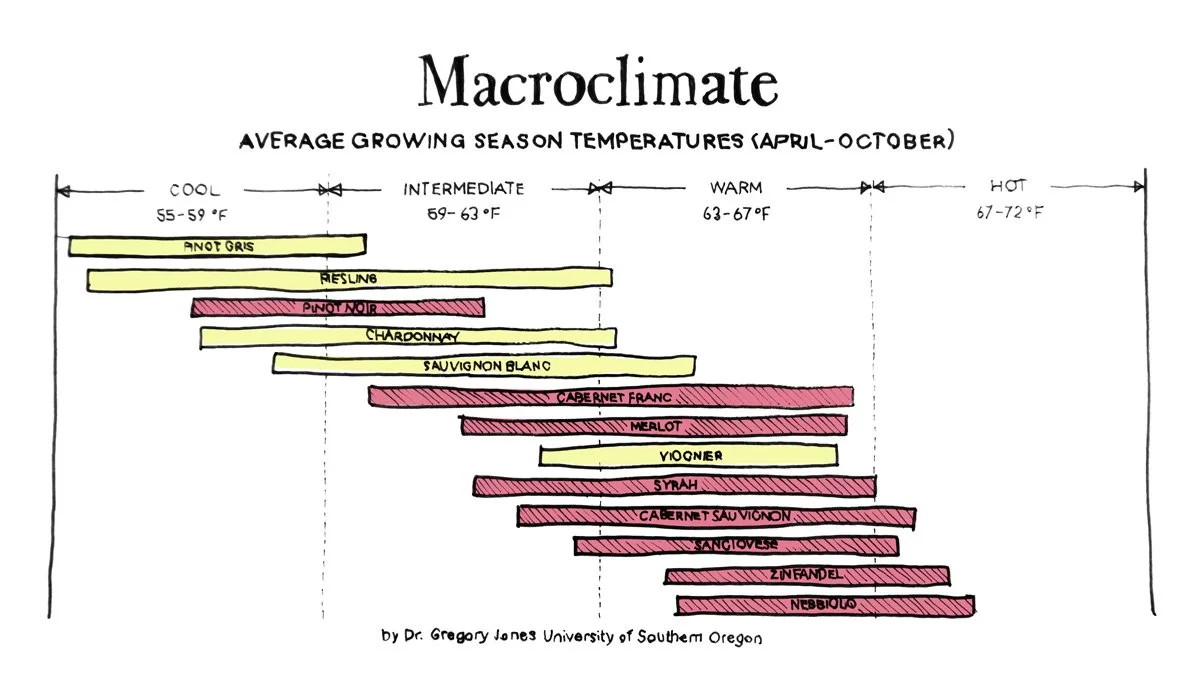
The region of Bordeaux produces mostly red wines, with some exceptions for white wines that thrive in similar climate conditions to red wines (i.e., Sauvignon Blanc). Because red wines generally require higher temperatures for growth, they are perfectly suited for Bordeaux, which is one of the warmest regions of France by average and peak temperature (~18 °C average and ~35 °C peak). By comparison, white wine growing regions in Italy (i.e., Alto Adige, Piedmont, Tuscany) have comparable average temperatures during growing season, but have significantly lower peak temperatures during the hottest months. In other words, the region of Bordeaux is unique in that the average temperature during the growing season is similar to or even lower than comparable wine-producing regions, but the peak temperature during the hottest months tops even the warmest regions.
Shouldn’t this mean that Bordeaux wines are sour and bitter for the reasons listed above? There’s one additional factor to consider that I intentionally omitted for dramatic effect: higher temperatures with optimal soil density means earlier harvests. Winemakers are not just sitting idle; they will monitor and assess the growth of their grapes and if ripe, may harvest earlier than prior years. In fact, some vignerons have been reported to harvest grapes at night to preserve acidity while allowing the grapes to fully ripen during the day. Earlier harvests preserve the acidity and freshness of the grapes, getting the best of both worlds if the grapes fully ripen. This is a trend that is prevalent across all of France due to rising temperatures, however, Bordeaux stands to gain the most.
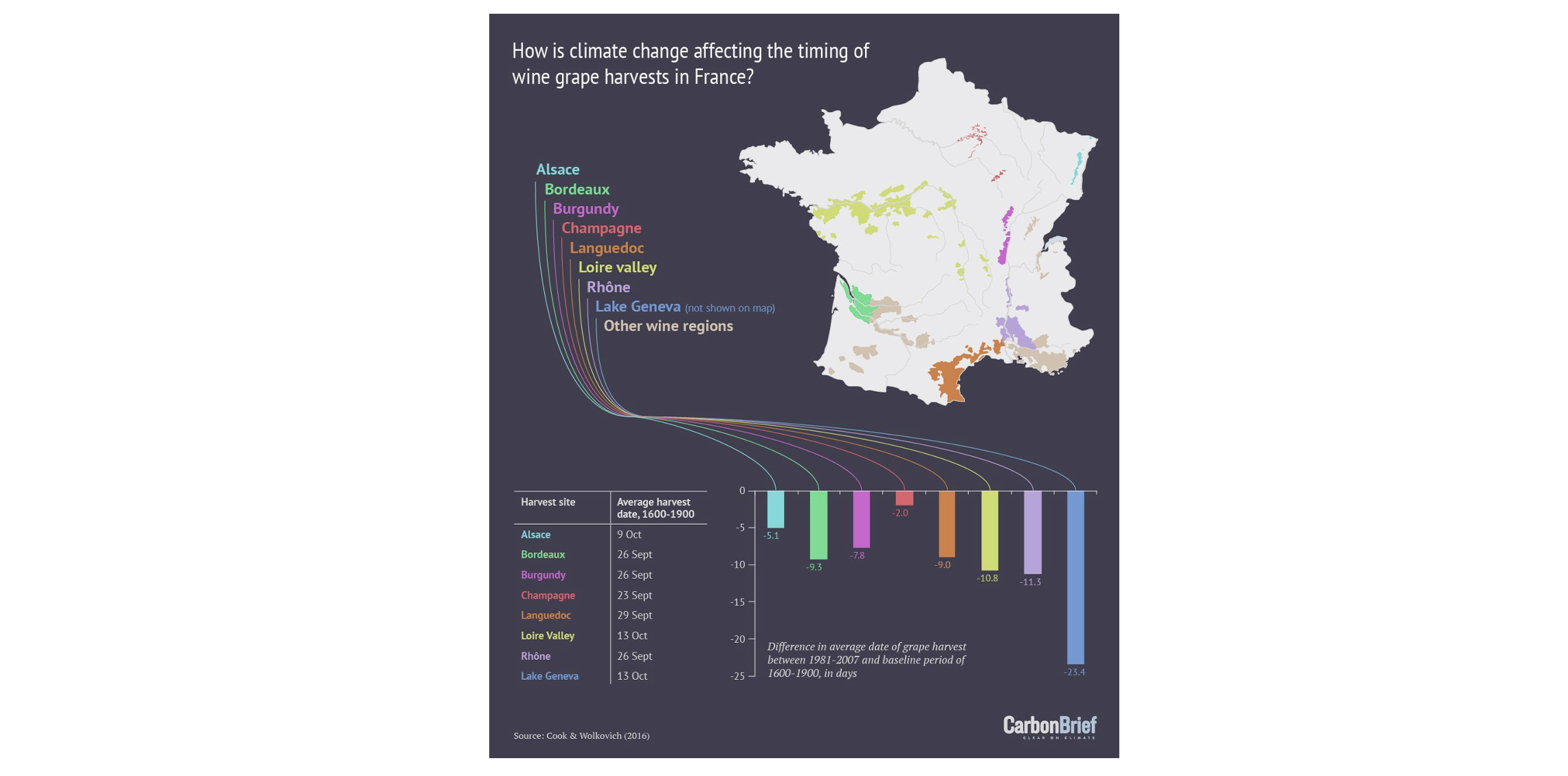
The average harvest period over the last 100 years has shifted more than nine days from the prior three centuries. While this may not seem like a large shift over a long period like a century, in winemaking, a harvest that is nine days earlier means that the grapes may taste substantially different from previous years. Grapes change dramatically over the last two to three days before harvest; grapes that are picked even a day too early may make for very amateur wines. On the other hand, as mentioned before, grapes may also benefit from an earlier harvest, developing a richer flavor and retaining more alcohol.
The name of the game is finding the exact right time to harvest.
Bordeaux Meteorological Outlook
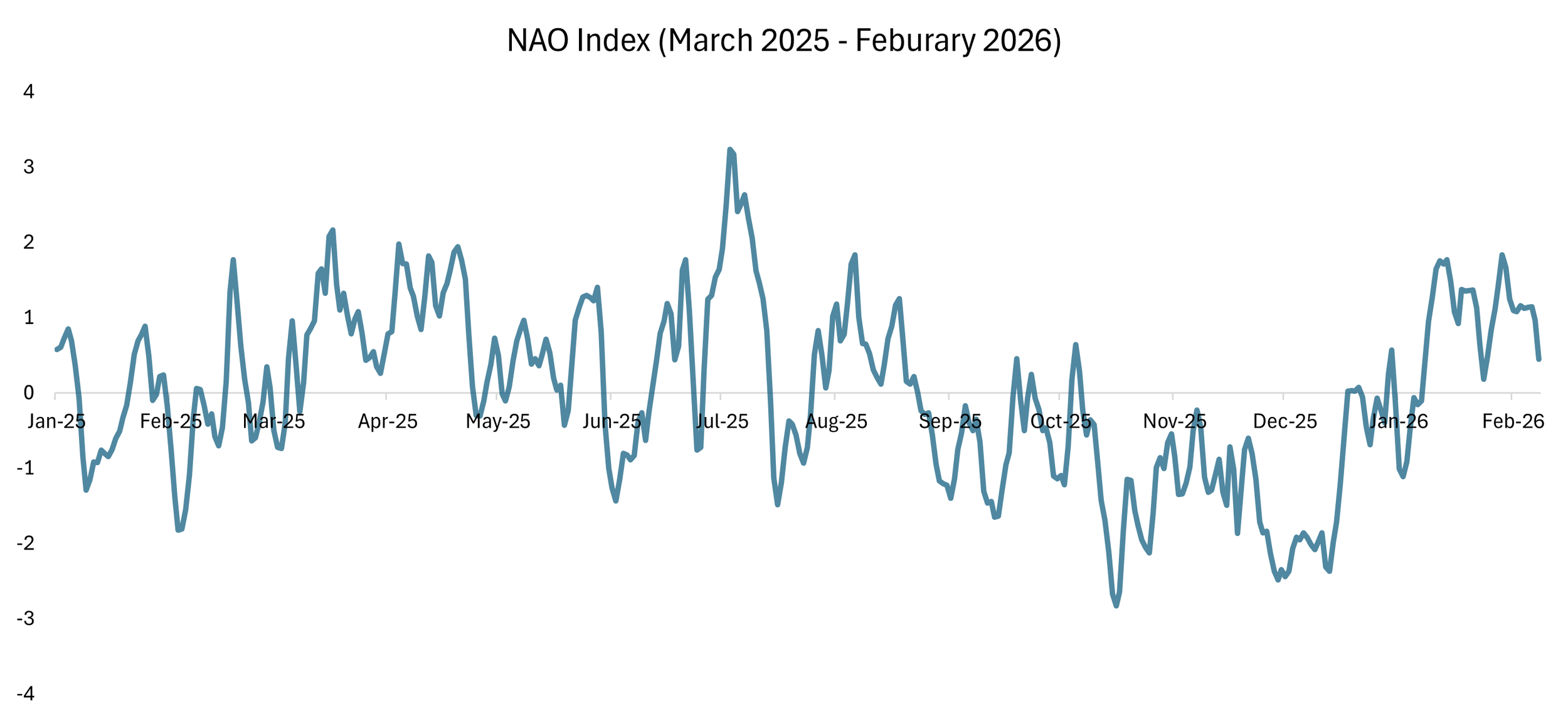
2026 is an important year for the world. The FIFA World Cup. The Winter Olympics. And most importantly, a good year for winemaking in Bordeaux. Short-term climate outlooks for early Spring 2026 tell us three things: cooler temperatures, humid conditions, and more rainfall. This is superbly beneficial for the early cycle of the growing season; the roots will see strong vegetative growth with reserves in the soil for the dryer half of the summer. This leads directly to more acidity and a balanced taste in the grapes. The second half of the growing season is much harder to predict, but based off of climate trends and early forecasts, 2026 will be a hot and dry summer. There are several metrics used to make (very) early estimations of summer temperatures, but the one we will focus on today is the North Atlantic Oscillation (NAO). The NAO index measures atmospheric pressure patterns in the North Atlantic and has a high degree of correlation with heat and dryness. The higher the NAO index, the higher likelihood of a hotter and dryer season.
Source: National Weather Service
The graph above shows the NAO index between January 2025 and February 2026. There are two major observations to be made:
The NAO index between January 2025 and February 2025 hovered at an average of near zero, which implied that we would have cooler summer. This is consistent with the milder heat of Summer 2025
The NAO index between January 2026 and February 2026 is significantly more positive than the equivalent period in 2025. This suggests an increased probability of a warmer and drier summer in 2026.
Naturally, these support levels are indicative up to a certain point; meteorologists will have a clearer idea of the climate closer to May of this year. However, based on the available data at this time, we can expect a warmer and dryer summer in 2026.
In summary, here’s the outlook: cooler and more rainfall in the Spring (first half of the growing season), warmer and dryer in the Summer and Fall (second half of the growing season).
Conclusion
Having established our expectations for the climate in Bordeaux in the Summer of 2026, what can we conclude about the upcoming harvest? First, rain early in the growing season will improve the taste profile of the grapes, but reduces the flowering (i.e., the number of grapes per bunch) and increases the risk of diseases like mildew or botrytis. So, the net effect is that the grapes will have higher quality and lower quantity. Then, in the second half of the summer, the heat further improves the quality of the surviving berries, as the water reserves from the rainier Spring will raise the skin-to-juice ratio and the warmer weather will accelerate sugar production and improve the maturity of the tannins. By the end of the summer, there will be a lower number of grapes to harvest, but the harvest will be perfectly ripened, acidic, and deeply concentrated. In particular, this formula is ideal for Cabernet Sauvignon and Merlots, both of which are staples of the Bordeaux region.
Higher quality and lower supply is the perfect recipe for a valuable wine, especially as a luxury good and coveted by wine collectors around the globe. As a result, the investment thesis today is to purchase 2026 Bordeaux wine futures - in particular, 2026 Cabernet Sauvignon or Merlot futures from Bordeaux. It'll be a few years until these wines (and derivatives) hit the market, so you'll have plenty of time to do your own research. Now, whether you would prefer to store away the wine until it appreciates or to enjoy it on your porch, is up to you.
References
Bordeaux Wine Vacations. 2025 Bordeaux Vintage Report. Bordeaux Wine Vacations, 2025.
https://bordeauxwinevacations.com/2025-bordeaux-vintage-report/Decotte, Juliette. “Climate Change Pushes Bordeaux Winemakers to Harvest at Night.” Phys.org, September 2023.
https://phys.org/news/2023-09-climate-bordeaux-winemakers-harvest-night.htmlHille, Katherine B. “NASA Study Finds Climate Change Shifting Wine Grape Harvests in France and Switzerland.” NASA, March 25, 2016.
https://www.nasa.gov/news-release/nasa-study-finds-climate-change-shifting-wine-grape-harvests-in-france-and-switzerland/National Geographic Society. “Climate Change Could Make French Wine Taste Better — for Now.” National Geographic, 2024.
https://www.nationalgeographic.com/environment/article/climate-change-french-wine-taste-betterReuters. “France Trims Wine Output Estimate After Summer Heatwave.” Reuters, October 7, 2025.
https://www.reuters.com/business/environment/france-trims-wine-output-estimate-after-summer-heatwave-2025-10-07/Reuters. “France’s 2025 Wine Output Forecast at Historic Lows for Second Year.” Reuters, November 7, 2025.
https://www.reuters.com/business/frances-2025-wine-output-forecast-historic-lows-second-year-2025-11-07/Reuters. “Hot, Dry Weather Seen Pushing French Wine Output Below Five-Year Average.” Reuters, September 9, 2025.
https://www.reuters.com/business/environment/hot-dry-weather-seen-pushing-french-wine-output-below-five-year-average-2025-09-09/ScienceDaily. “Warm Summers and Wet Winters Yield Better Wine Vintages.” ScienceDaily, October 11, 2023.
https://www.sciencedaily.com/releases/2023/10/231011182135.htmUniversity of Oxford. “New Study Finds That Warm Summers and Wet Winters Yield Better Wine Vintages.” Oxford News, October 12, 2023.
https://www.ox.ac.uk/news/2023-10-12-new-study-finds-warm-summers-and-wet-winters-yield-better-wine-vintagesWood, Andrew, et al. “Seasonal Climate Impacts Wine Quality in Bordeaux.” iScience 26, no. 10 (2023).
https://www.sciencedirect.com/science/article/pii/S258900422302031XNational Oceanic and Atmospheric Administration (NOAA). “North Atlantic Oscillation (NAO).” Climate Prediction Center.
https://www.cpc.ncep.noaa.gov/products/precip/CWlink/pna/nao.shtml